The world of music education is evolving. With virtual tools becoming more sophisticated, more students and families are asking us, “Should we choose online lessons or in-person private lessons?”
As instructors who’ve taught in both formats, we believe that the right choice depends on your goals, schedule, and learning style. Let’s break down the key factors so you can make the most informed decision.
Studio, Online, or At Home: What Each Format Actually Offers
Every format has something real to offer, and the right choice usually comes down to your child’s age, personality, and what your week actually looks like. Here’s how they break down:
Studio lessons give your child a dedicated space away from home. For some kids, that separation helps. It signals that this time is set aside, and nothing else is competing for it.
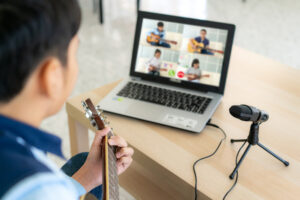
Online lessons remove the commute entirely and open up access to teachers beyond your immediate area. The tradeoff is that they ask more from both the student and the parent, a quiet space, a reliable setup, and enough structure to keep a child focused on a screen.
In-home music lessons bring a skilled, experienced teacher directly into the environment where your child already feels comfortable. No transition time, no adjustment period, no backseat energy to shake off before the lesson begins. The teacher arrives, and the work start
Each format can produce a great outcome. What tends to separate them is less about quality and more about fit.
| Studio | Online | Lessons In Your Home |
|
|---|---|---|---|
| Getting there | You drive to them Adds time before and after every session, especially with younger kids | No travel at all Works well if your setup at home is quiet and distraction-free | The teacher comes to you No prep, no commute. Your child starts the lesson already at ease |
| The learning environment | Dedicated music space Helps some kids focus, but it’s not their practice space at home | Wherever they sit Familiar, but screen fatigue and distractions can work against you | Their own space The teacher sees how your child actually practices and adjusts from there |
| Teacher quality | Depends on the studio Quality varies. Rotation is common, especially in larger schools | Wide range available Geography is no longer a limit, but vetting still falls on you | Vetted, experienced instructors Every teacher is screened, matched to your child, and stays consistently |
| Knowing your child | Limited over time Hard to build depth when the setting changes or teachers rotate | Possible, but harder A screen creates distance that takes longer to close, especially for shy kids | Built into the format Same teacher, same home, every week. The relationship builds naturally |
| Best for | Families who want a structured, out-of-home routine for their child | Older students with busy schedules or families in areas with fewer local options | Families who want a skilled teacher who genuinely gets to know their kid |
Benefits of Online Music Lessons
Online lessons have come a long way, and for many families, they are genuinely the right call. A few reasons they work so well:
They save real time. Parents do not have to drive to and from lessons each week. For busy households, that adds up quickly.
They open up your options. You are not limited to teachers in your zip code. The right instructor might be across town or across the country, and online makes that possible.
They meet students where they practice. A teacher joining your child at their actual instrument, in their actual space, can help them get more out of their daily practice, not just the lesson itself.
Many of our students thrive in this format, especially older kids with packed schedules or those already comfortable on digital platforms. The Music Educators Journal has published research and case studies on what makes virtual music learning work if you want to dig deeper.
READ: What Age Can a Child Begin to Take Music Lessons Online?
When In-Person Lessons Make More Sense
Online is not always the right fit, and it is worth being honest about that.
Very young students, particularly those ages four to six, often do better in person. A teacher in the room can redirect attention, adjust posture, and respond to a child’s energy in ways a screen simply cannot match. For instruments like drum set or anything involving ensemble coordination, live instruction also tends to produce faster and clearer results. And for students with sensory sensitivities, the physical consistency of an in-person setting can make a real difference in how comfortable and focused they feel.
It does not have to be one or the other, either. A lot of families mix formats depending on the season, travel schedules, or whatever life is throwing at them that month.
Why the Home Environment Changes the Lesson
At Lessons In Your Home, our teachers are trained musicians and experienced educators who know how to build a strong technical foundation, keep students genuinely engaged, and pace learning in a way that challenges without overwhelming. They bring that same level of skill and preparation regardless of format. What the home setting adds is context.
A teacher in your home can see how the instrument is positioned, what the practice space looks like, and what might be competing for your child’s attention. They can adjust not just how they teach, but what they work toward, because they understand the full picture. A child who seems distracted or closed off in another setting often opens up on familiar ground. That shift changes what’s possible in a lesson.
The online vs. in-person music lessons debate is often framed as a convenience question. For many families, it turns out to be a question about how their child actually learns best.
How to Know Which Format Is Right for Your Child?
No single format is right for every family. Online lessons offer real flexibility and access to excellent teachers beyond your immediate area. Studios offer structure and a dedicated environment. In-home lessons offer consistency, comfort, and a teacher who gets to know your child over time in a way that’s harder to replicate anywhere else.
What carries a student through years of learning, through the frustrating plateaus and the small breakthroughs, is a teacher who is both excellent at their craft and genuinely invested in the person sitting across from them. The format gets you started. The teacher is what makes it last.
Find a Teacher Who Feels Like the Right Fit
The right teacher can shape so much more than a lesson. When your child feels comfortable, understood, and encouraged, music has room to become part of who they are.
If you’re looking for a teacher who brings skill, warmth, and real attentiveness into your home, we’d love to help.
FAQ: Online Lessons vs In-Person
Yes. With a qualified teacher and a consistent routine, students make real progress online. The format works best when there’s a quiet space, a reliable setup, and a parent who can help hold the structure, especially for younger children.
In-home lessons work well across all ages, but younger children in particular tend to benefit from learning in a familiar environment. It lowers the threshold for focus and makes it easier for the teacher to build rapport from the start.
Not usually. Many families move between formats depending on the season or schedule and find that a strong teacher-student relationship carries through the transition without much disruption.
Our teachers are accomplished musicians and experienced instructors who come prepared to teach well every single session. Because they come to you, they also get to know your child in a way a rotating studio setting rarely allows, and that familiarity tends to show up in how your child progresses.